Google Autocomplete
What Are Long-Tail Keywords?
Specific searches often reveal the job a reader needs done. Find that job, group the phrases that share it, and build a page around the answer.
Try the coffee grinder exampleThe “tail” describes search demand
New search
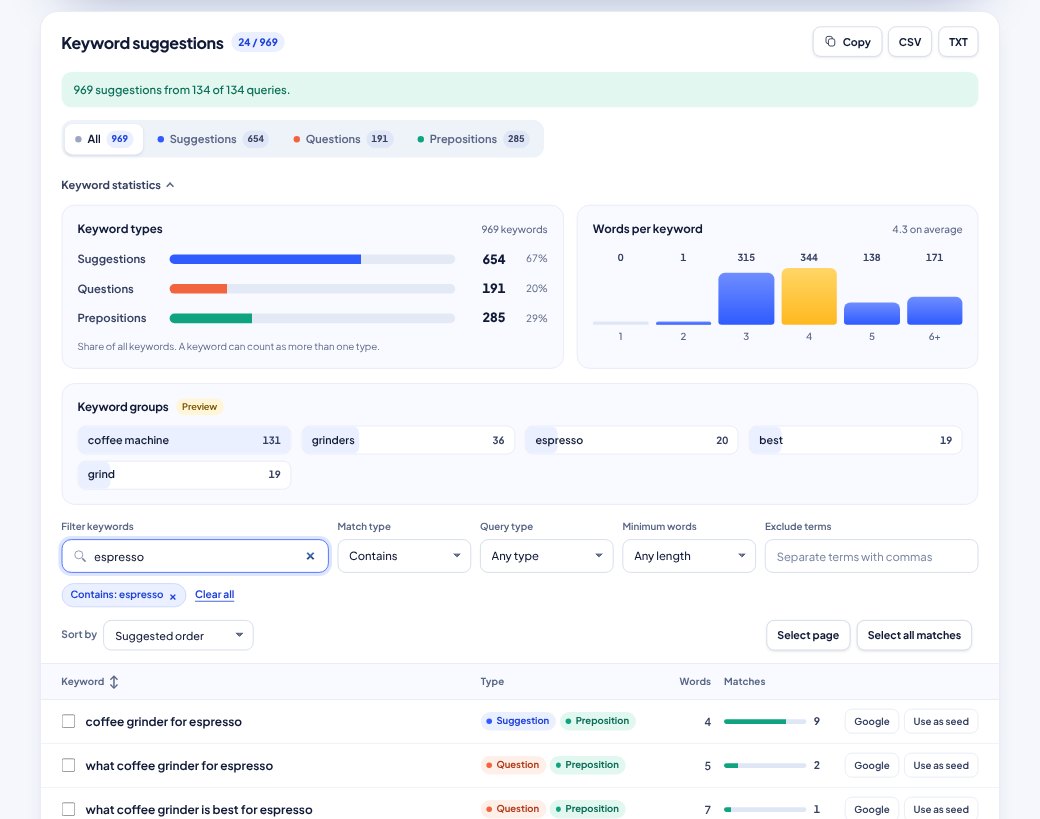
Keyword suggestions 0
Search comparison
New keywords
Missing keywords
Save your results and explore keyword groups with a free account.
Keyword statistics
Share of all keywords. A keyword can count as more than one type.
Keyword groups Preview
Your results will appear here
Enter a seed keyword to start exploring suggestions.
The added words change the page
These phrases appeared in our US coffee grinder run. Each needs a different kind of detail.
coffee grinder
coffee grinder under 100A budget-led buying decision
Explain which options fit the budget and the brewing methods they suit. Include current prices and what the reader gives up at this price point.
coffee grinder for french pressA brewing requirement
Investigate coarse-grind consistency, capacity, and cleanup. Use tests or product evidence that help someone choose for this brewing method.
how long do coffee grinder burrs lastA maintenance decision
Explain the signs to inspect and what the owner can do next. Replacement guidance should account for the grinder model and its manual.
US English · November 25, 2026. Open the original search screenshot
Group by the answer you would give
Compare the task, the pages already ranking, and the evidence you could add. Similar wording is a starting clue.
coffee grinder for french press
best grinder for french press
how to replace grinder burrs
The first two phrases can share product tests, recommendations, and a comparison table.
A separate task needs a procedure, model guidance, and its own supporting photos.
How to check whether two phrases need separate pages
Search both phrases in the same market. Compare the dominant page types and the problems they solve. If your proposed answers would repeat the same product list and advice, one well-developed page may cover both. A different process or audience can justify a separate page.
Look for evidence of a useful task
A volume estimate is one input. Keep your reasoning with the shortlist so you can revisit the decision later.
- Recognizable needA customer asks the question, a product constraint matters, or the phrase appears in your research.
- A clear answer you can provideYou have first-hand examples, tests, photos, or a procedure that helps the reader act.
- A suitable place on your siteThe idea strengthens an existing topic or supports a separate page with a distinct purpose.
- A way to check the outcomeAfter publishing, review Search Console queries and impressions alongside the page’s actual usefulness.
Where search estimates fit
Paste a shortlist into Keyword Planner for estimates in your chosen market. Keep the locale consistent with your autocomplete search. Its historical metrics and forecasts answer different planning questions, so check which view you’re using. Google’s Keyword Planner instructions.
From one phrase to a content brief
A useful brief makes the reader’s decision concrete before you start writing.
Choose a coffee grinder for French press
- Reader
- Someone making French press coffee at home who needs a grinder that suits a coarse grind.
- Decision to help with
- Which grinder fits their batch size, budget, and willingness to grind manually.
- Evidence to collect
- Comparable grind samples, capacity measurements, cleanup photos, and current prices.
- Page outline
- Quick picks, the test method, coarse-grind results, trade-offs, and buying questions.
This is a proposed brief. Google’s guidance emphasizes original information and a satisfying answer. People-first content guidance
Long-tail keyword basics
What is a long-tail keyword?
A specific search phrase with relatively low demand on its own. The name comes from the shape of the demand curve: a few broad terms get most searches, and a long tail of specific ones each get few. Together those specific searches make up a large share of all queries on a topic.
Does a long-tail keyword have to be long?
No. A short model number or niche term can have little demand. A long question can be popular. The tail describes the demand distribution. Word count is a practical way to surface detail while you research.
How do I find long-tail keywords for a new site?
Start with products, services, or problems you can cover well. Collect modifiers and questions, group phrases by task, and inspect the current results for each candidate. Begin with pages for which you can provide concrete evidence and maintain the information. Open the long-tail keyword generator.
Should I create a page for every variation?
No. Map related phrases to the same answer. Publish a separate page when it serves a distinct task and you can develop it fully. Use internal links to connect supporting guides to the broader topic.
What is the difference between a keyword group and a content cluster?
The tool groups phrases using recurring words. A content cluster is your editorial structure, built around the topics and answers readers need. Review the groups and combine or split them as the intent requires. Keyword clustering step by step.