Google Autocomplete
Free Question Keyword Generator
Find what people want to understand, choose, or fix. Turn question keywords into clearer guides and useful FAQ sections.
Find question keywordsHow air fryer worksUnderstand the product
What air fryer should I buyMake a choice
Why air fryer not workingSolve a problem
New search
Question keywords 0
Search comparison
New keywords
Missing keywords
Save your results and explore keyword groups with a free account.
Keyword statistics
Share of all keywords. A keyword can count as more than one type.
Keyword groups Preview
Your results will appear here
Enter a seed keyword to start exploring suggestions.
Find questions around your topic
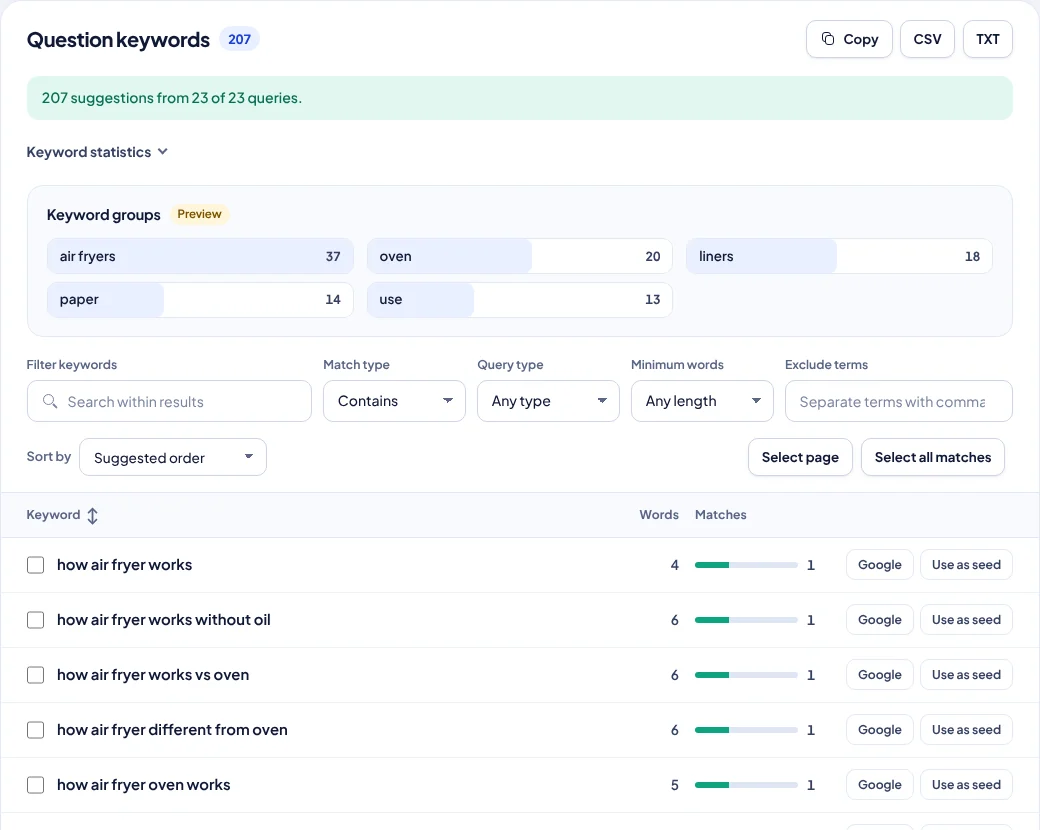
Our air fryer run shows the words Google returned. Use them to understand the question, then write a clear heading in natural English.
Focus on one concern
Filter for works, clean, size, or another part of the topic. Exclude a phrase when it belongs to an audience or use case you do not cover.
Combine equivalent questions
“How air fryer works” and “how air fryer oven works” may belong under one explanation. Check the result pages and the product context before giving them separate articles.
Keep the evidence with the list
The CSV includes the locale and source queries from your run. Use those details to remember which market you researched when you revisit the list.
One search tries 23 question openers
In English the generator tries how, what, why, when, where, which, who, can, does, is, are, should, will, and longer openers such as “how much” and “where to buy”.
Keywords starting with each word
How and what led this search
They cover instructions and definitions. For a product topic they often make up the largest part of the question list.
Can, is, and does are yes-or-no questions
“Can coffee grinder grind spices” wants a short verdict first and the reasoning after. These fit well into an FAQ.
Which and where point to a purchase
“Which coffee grinder should i buy” is a buying decision. Answer it with a recommendation, not a definition.
A heading, an FAQ, or a whole guide?
Start with the answer you need to give. Open a branch for an example.
What would a useful answer need?
A short clarificationAdd an FAQ to the relevant page
A question about one feature can fit after the section that explains it. Answer directly, then link to the detailed instructions if the reader needs them.
A comparison or demonstrationBuild a substantial section
For “how air fryer works vs oven,” explain the practical differences with a side-by-side cooking example. It may sit in a broader comparison if it serves the same decision.
A different task with several stepsPlan a dedicated guide
“Why air fryer not working” calls for diagnosis. Organize the guide by symptom and use the model’s own manual for procedures.
Turn a raw question into a useful outline
An editorial example using one returned phrase.
How does an air fryer work?
- Reader’s task
- Understand how the appliance cooks food before deciding how to use it.
- Open with
- A concise explanation, followed by a labeled diagram of the fan, heating element, and basket.
- Develop the answer
- Explain circulation, space around the food, and how the cooking method differs from an oven.
- Useful evidence
- Your own appliance photos, a controlled cooking example, and the manufacturer’s operating guidance.
Google recommends original information and a complete answer to the reader’s task. Its people-first content guidance
About question keywords
Where do the questions come from?
The tool combines your seed with question patterns in the chosen language, then collects Google Autocomplete predictions. Returned wording depends on the seed, market, and time of the search. How Google explains predictions.
Are these People Also Ask questions?
No. This tool collects autocomplete predictions. People Also Ask is a separate section on Google’s result pages. When you research both, record the source so you can tell how each idea was found. Four ways to find questions people ask.
Can I use it as an FAQ generator?
It gives you the questions, taken from real predictions. You write the answers. Pick questions the page does not already answer, rewrite them into natural language, and keep each answer short and specific.
Can I research questions in other languages?
Choose the language and country before starting. The question patterns change with the selected language. If a phrase sounds unusual, check the intended meaning and the actual search results before publishing it.
Should I use the exact returned phrase as a heading?
Write a grammatical heading that preserves the need behind the query. Autocomplete can return shorthand. “How air fryer works” can become “How does an air fryer work?” in your article.
Can I collect suggestions and modifiers too?
Choose All types to fill the Suggestions, Questions, and Prepositions tabs in one run. The focused Questions mode is selected on this page when you first open it.
Will answering these questions guarantee a featured result?
No. A useful answer gives the page a clear purpose. Google decides which pages and search features to show. Evaluate the content by how well it answers the question and track its performance after publication.