Google Autocomplete
Free Long-Tail Keyword Generator
Find the detail that changes what someone needs. Start with three-word phrases, then narrow by use, feature, or audience.
Find long-tail keywordsEach added detail changes the brief
- A broad topicstanding desk
- A feature to comparestanding desk with drawers
- A specific buying decisionstanding desk with drawers for small spaces
New search
Keyword suggestions 0
Search comparison
New keywords
Missing keywords
Save your results and explore keyword groups with a free account.
Keyword statistics
Share of all keywords. A keyword can count as more than one type.
Keyword groups Preview
Your results will appear here
Enter a seed keyword to start exploring suggestions.
What makes a keyword more specific?
A useful modifier changes the answer, the product shortlist, or the instructions. Open an example to see what you would cover.
Use casestanding desk for small spaces
Compare the footprint, usable surface, and room needed to raise the desk. A generic list of large office desks would leave this reader’s question unanswered.
Featurestanding desk with drawers
Check storage depth, leg clearance, and how cables behave as the desktop moves. These are practical differences to investigate before recommending a model.
Compatibilitystanding desk converter for two monitors
The reader already has equipment. Explain usable width, load limits, and whether a separate keyboard tray fits the setup.
Problemstanding desk not going up
Plan a troubleshooting guide around checks and the manufacturer’s reset procedure. The searcher needs a way to diagnose their existing desk.
Planning examples illustrate different intents. Verify a candidate against the live suggestions and the pages already ranking for it.
Start broad and keep the useful detail
Our English US search for standing desk with the three-word filter active.
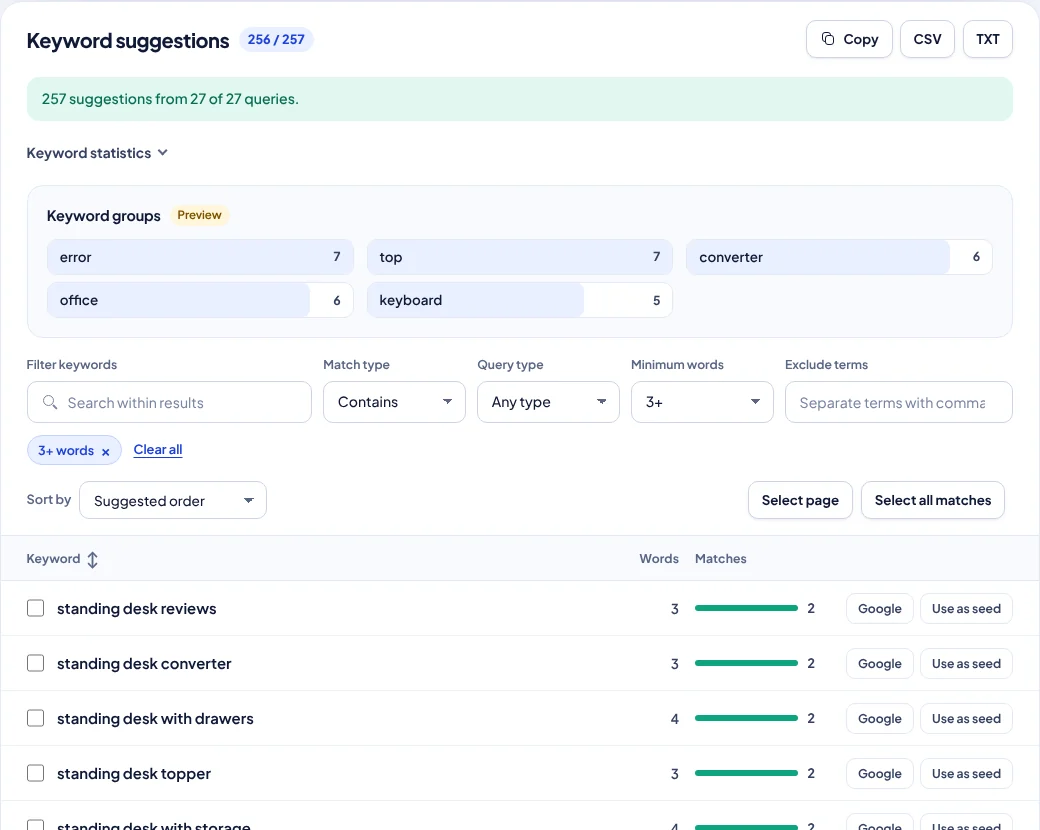
Three words is a useful starting filter
It helps you see modifiers quickly. Check the actual need behind each phrase too. A short product model may be very specific, while a long phrase may still leave the task unclear.
Explore a result as a new seed
Use as seed starts another run from that phrase. A feature such as drawers can lead you to narrower storage or space questions. Back to results returns to your earlier list.
Export a page-sized shortlist
Filter for one angle, exclude unrelated terms, and select representative phrases. Download CSV or TXT as a guest. With a free account, you can also filter by keyword group and save lists.
How to find long-tail keywords
The same routine works for a product, a service, or a topic you want to write about.
Enter the two or three words a customer would use for the product or problem. Leave the minimum at three words, or raise it, and sort by Most source matches to see the phrases that several queries returned.
Then pick one angle. Filter by a word such as “for”, “with”, or “small”, and exclude brands or uses you do not cover. When a phrase looks promising, choose Use as seed to search around it, and export your shortlist at the end.
Prepositions often carry the detail. Search preposition keywords only
A new keyword needs a place
Match your content structure to the reader’s task.
Explain a related feature where the reader already compares those products.
A compact setup or a compatibility requirement can justify its own shortlist.
A desk reset procedure should be easy to find without reading a product roundup.
Long-tail keyword questions
How do I find long-tail keywords for free?
Enter a broad topic, keep the three-word minimum, and run the search. Filter the list by a use, feature, or problem, then export the phrases that fit a page you could write. Searching, filtering, and exporting are free without an account.
Is every three-word phrase a long-tail keyword?
Length is a convenient filter. Long-tail searches sit at the lower-demand end of a topic, and the phrase can be short. Look at the specific task and check demand separately when you need an estimate. Read the long-tail keyword guide.
Can a keyword with no reported volume be useful?
Yes, if it describes a customer need you can address. Check product questions, support requests, and the search results for more context. Once the page is live, Search Console impressions can help you see which queries it actually reaches.
Does a long-tail keyword have less competition?
Inspect the results for that exact query before deciding. A specific phrase can still attract strong competitors. Look at whether the ranking pages solve the same task and whether you can add first-hand testing or clearer instructions.
How many long-tail keywords should one page target?
One main phrase and the variations that need the same answer. Phrases that call for a different product shortlist or a different procedure belong on another page. How to group keywords by intent.
Can I search for questions at the same time?
All types collects suggestions, questions, and prepositions in one run. Use the result tabs to view each type. The question keyword generator starts with a focused question search.
Do I need an account to export?
No. You can copy or download the filtered results as a guest. Select rows to export only those phrases, or leave the selection empty to export every match.